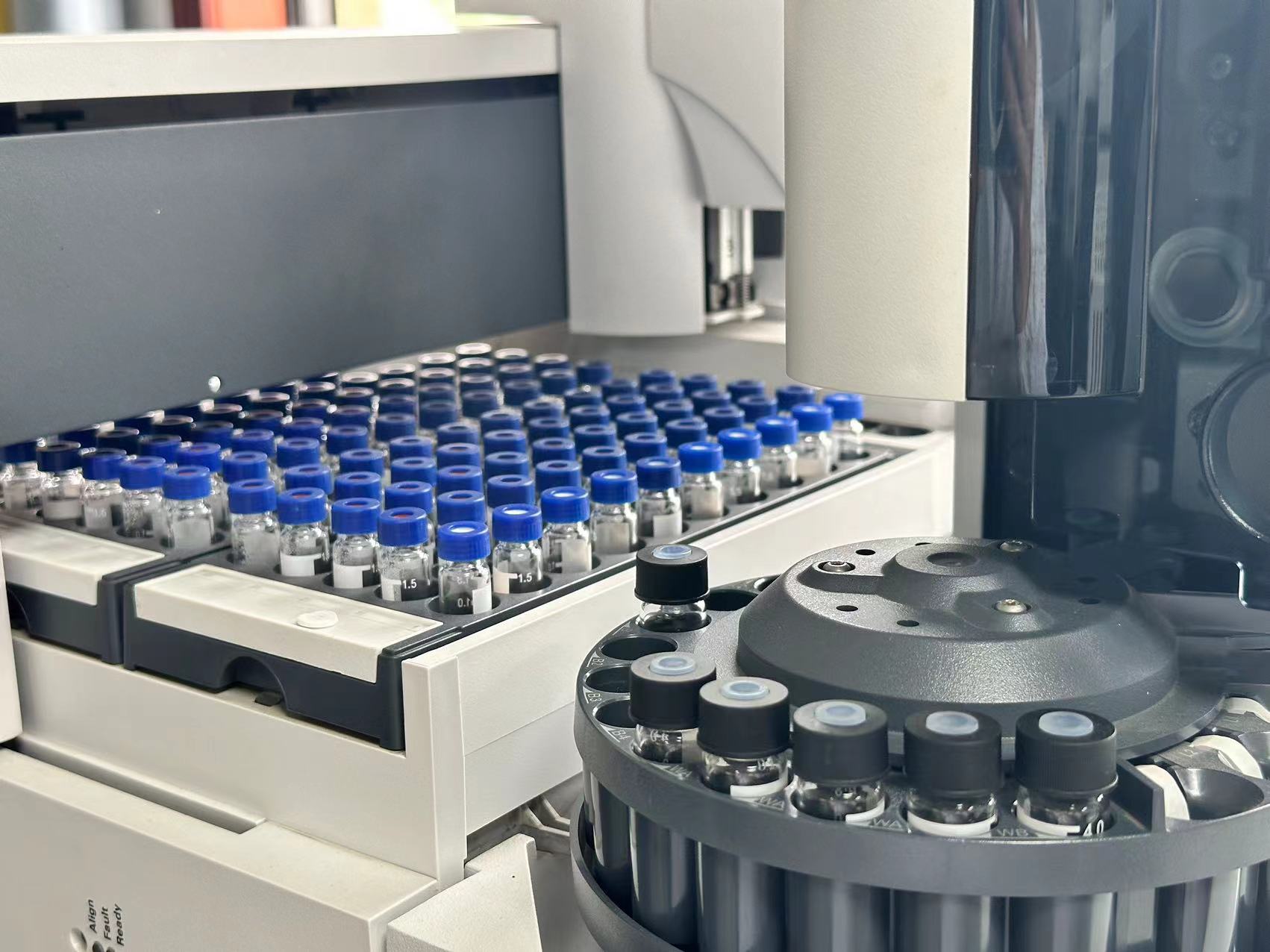
A 12-run sequence for an assay of a sulfated impurity came back with an RSD of 6.8% on peak area, and the bracket standard at the end had drifted 11% low. The method was validated, the column was new, the autosampler passed its pressure test. The failure traced to septa that had been in the tray for three shifts, and the USP requirements for aijiren brand in a validated method had not been applied to the consumable layer at all. The lab had treated vials and closures as interchangeable hardware. USP does not.
USP General Chapter 621 (Chromatography) governs system suitability, resolution, tailing, and repeatability. It does not name a vial brand, and it does not name aijiren. What it does is set the performance envelope that every component inside the sample path must support. When a method is validated under 621, the injection precision requirement is typically an RSD of ≤1.0% for replicate injections of the standard solution. That number is the real specification that reaches down to the vial, the cap, and the septum.
If the consumable introduces a variable that the method did not account for, the system suitability test fails and the run is invalid. I have seen a 0.4% RSD method pushed to 1.6% by a septum lot that cored on the third puncture. The method was not at fault. The consumable specification was missing from the validation package, and that is where most labs get into trouble. They validate the instrument, the column, the mobile phase, and the detector, but they do not validate the closure system as a controlled variable.
Chapter 621 also requires that the injection volume be reproducible. For a 10 µL injection, a ±1% volume error is 0.1 µL. A septum that leaks under repeated puncture changes the effective injection volume because the needle pulls a partial vacuum on the draw. That error is not visible in the chromatogram as a discrete peak. It shows up as area drift across a sequence, and it is the first thing I check when a validated method starts failing at the back end of a run.
Chapter 1664 and the extractables question that USP leaves partly open
USP General Chapter 1664 (Assessment of Drug Product Leachables Associated with Pharmaceutical Packaging/Delivery Systems) applies to packaging systems that contact a drug product. A chromatography vial is a sample container, not a drug product container, but the same logic applies when the sample is a finished pharmaceutical formulation. If the septa or the vial liner contributes an extractable that co-elutes with an analyte of interest, the method reports a false result.
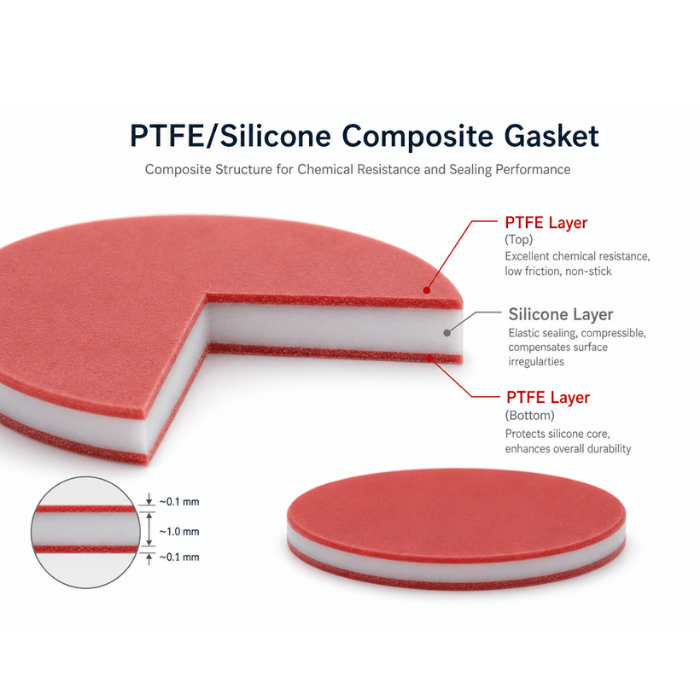
Chapter 1664 does not give you a pass/fail list of extractables. It gives you a framework for assessing risk based on the sample matrix, the contact time, the temperature, and the solvent. That is the part labs must own. A Aijiren brand vial with a PTFE/silicone septum will behave differently in a pH 2.0 aqueous sample than in a 100% acetonitrile sample. The PTFE layer is inert, but the silicone core can release low-molecular-weight siloxanes under aggressive solvent conditions. I have traced ghost peaks at m/z 281 and m/z 355 in LC-MS methods to silicone extractables from a closure that was rated for HPLC but not for the specific solvent system in use.
The practical requirement is this: qualifying a consumable for a validated method means running a blank extraction under the method's worst-case conditions. For aijiren vials, that means filling a vial with the actual mobile phase or diluent, capping it with the actual septum, storing it at the method temperature for the maximum sample residence time, and injecting it. If the blank is clean at the method's detection limit, the consumable is qualified for that method. USP 1664 will not do that test for you.
What USP actually requires versus what the lab must specify itself
There is a persistent misconception that USP publishes a list of approved vial brands. It does not. USP publishes performance requirements and general test methods. The lab is responsible for translating those into a consumable specification. For aijiren brand vials in a validated method, that translation looks like this:
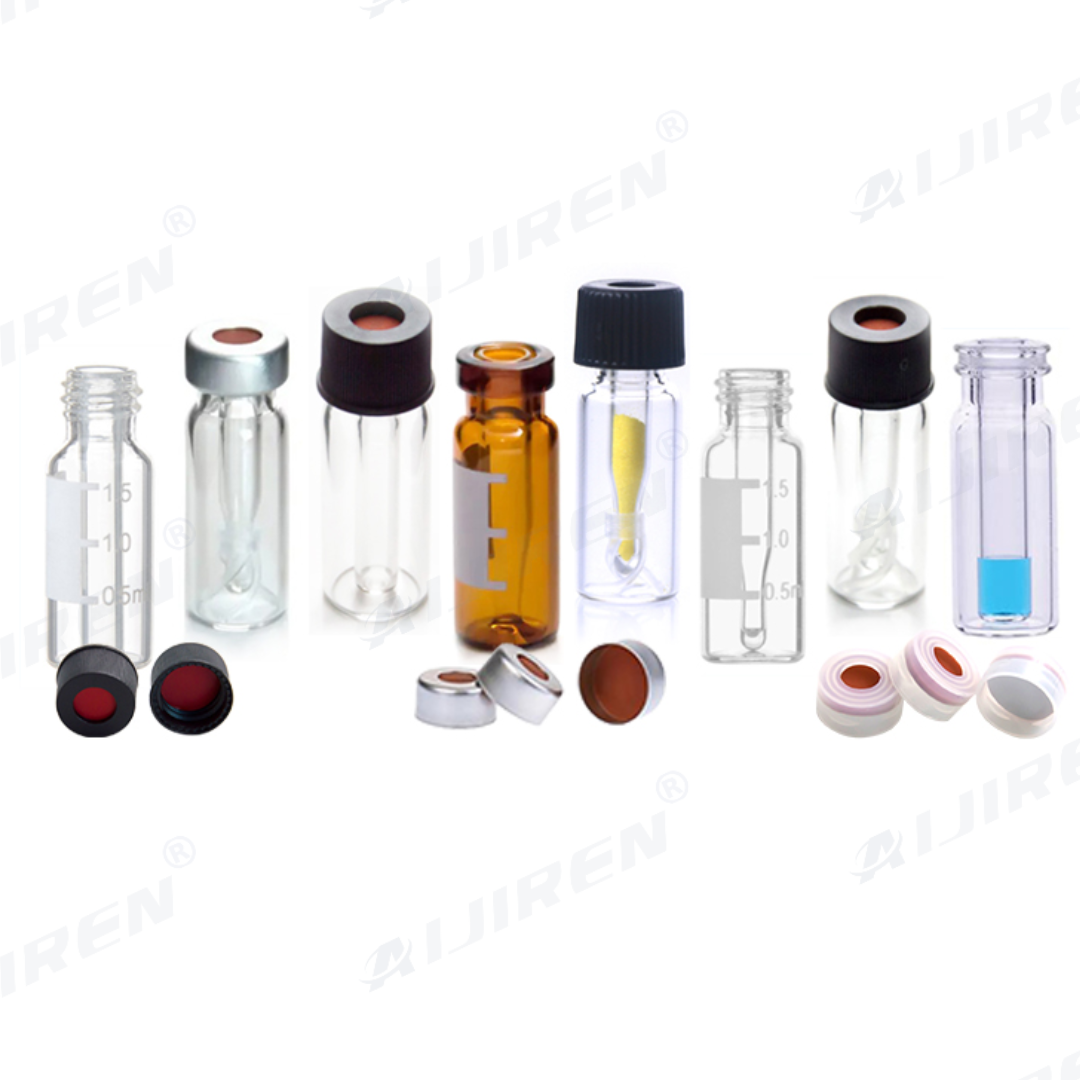
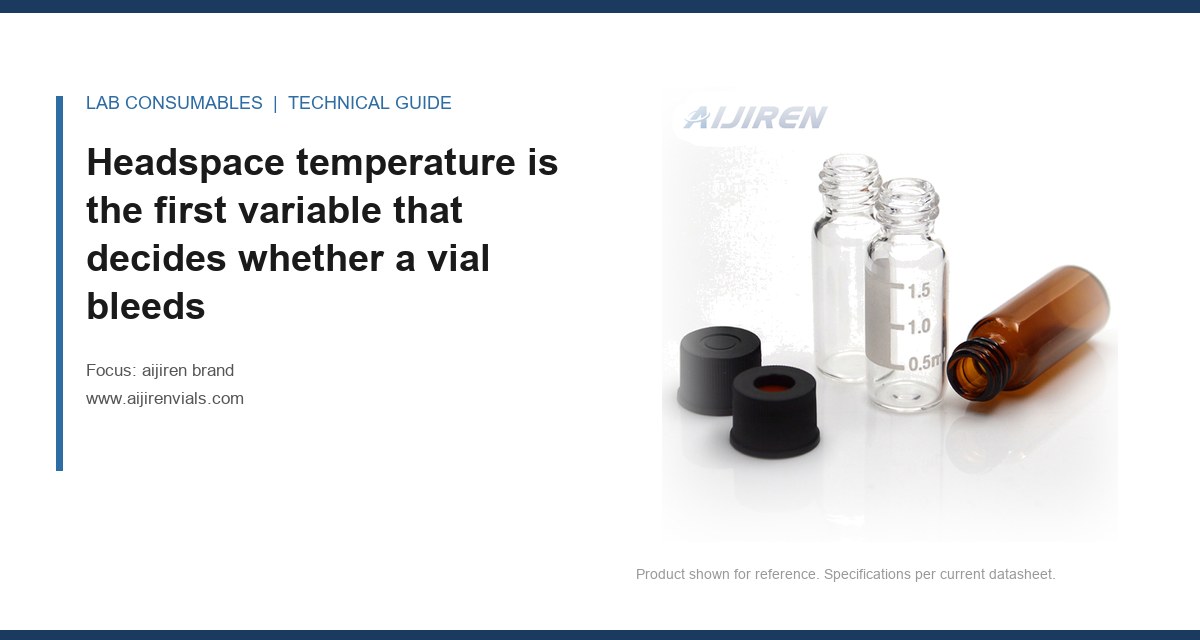
- Dimensional fit: The vial must match the autosampler tray geometry. A 12 x 32 mm vial does not fit a tray designed for 8 x 40 mm inserts, and a 9 mm screw cap does not seal a 10 mm crimp neck. This is not a USP requirement. It is a mechanical prerequisite that USP assumes you have already met.
- Closure integrity: USP 381 (Elastomeric Closures for Injections) defines physical and chemical tests for elastomeric closures used in injectable drug packaging. A chromatography vial septum is not an injectable closure, but the self-sealing requirement in 381 is the closest USP analog. A septum that does not reseal after puncture allows sample evaporation and solvent loss, which changes concentration and violates the method's accuracy requirement.
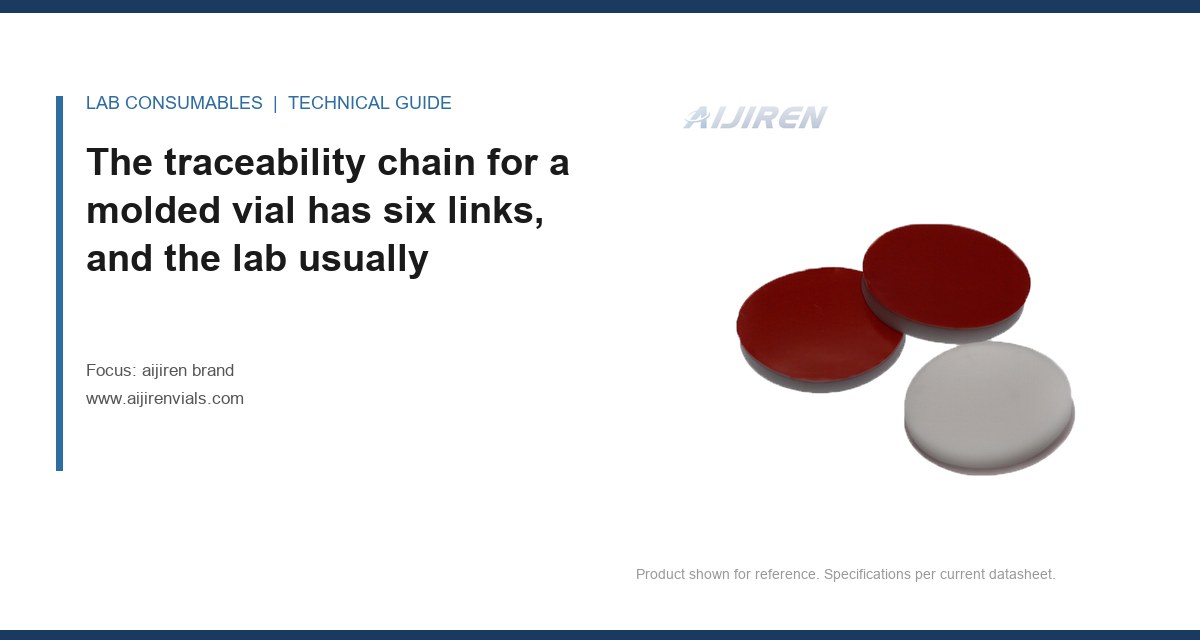
- Chemical compatibility: USP 661 (Plastic Packaging Systems and Their Materials of Construction) sets extractables and physicochemical test requirements for plastic packaging. A polypropylene vial cap and a PTFE/silicone septum fall under this logic when the sample is aggressive. The chapter does not list aijiren by name, but the material requirements apply to any polymer in the sample path.
- Particulate burden: USP 788 (Particulate Matter in Injections) applies to injectable drug products, not to sample vials. However, a vial that sheds glass particles or polymer fragments into the sample can foul the injection needle and the column frit. I have replaced a column after 40 injections because a damaged vial neck was generating glass fines that packed the inlet frit and raised backpressure by 30 bar.
The split is clean: USP tells you what the method must achieve. It does not tell you which consumable achieves it. The lab writes the consumable specification, and that specification becomes part of the validation package. When an auditor asks how the vial was qualified, the answer cannot be "it is USP compliant" because USP does not issue that statement for vials.
The closure system is the failure point USP cares about most
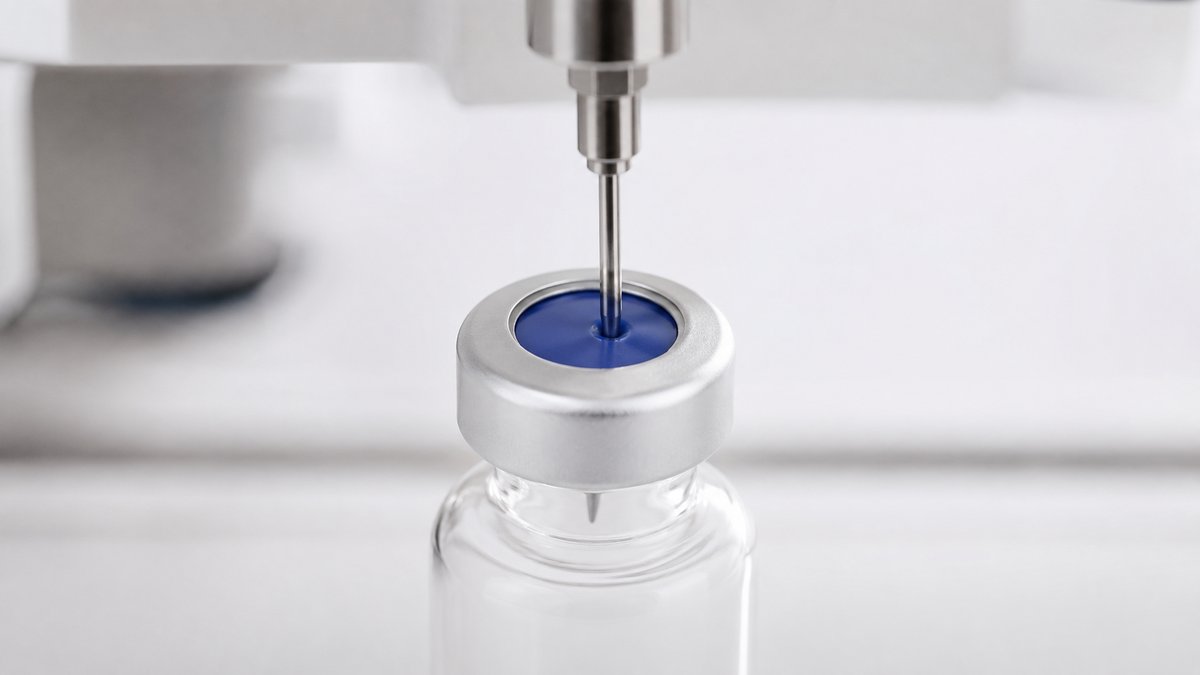
If I had to rank consumable failure modes by how often they invalidate a validated method, the closure system is first by a wide margin. The vial body rarely fails. The septum fails constantly. The reason is mechanical: every injection is a puncture event, and every puncture event degrades the sealing surface.
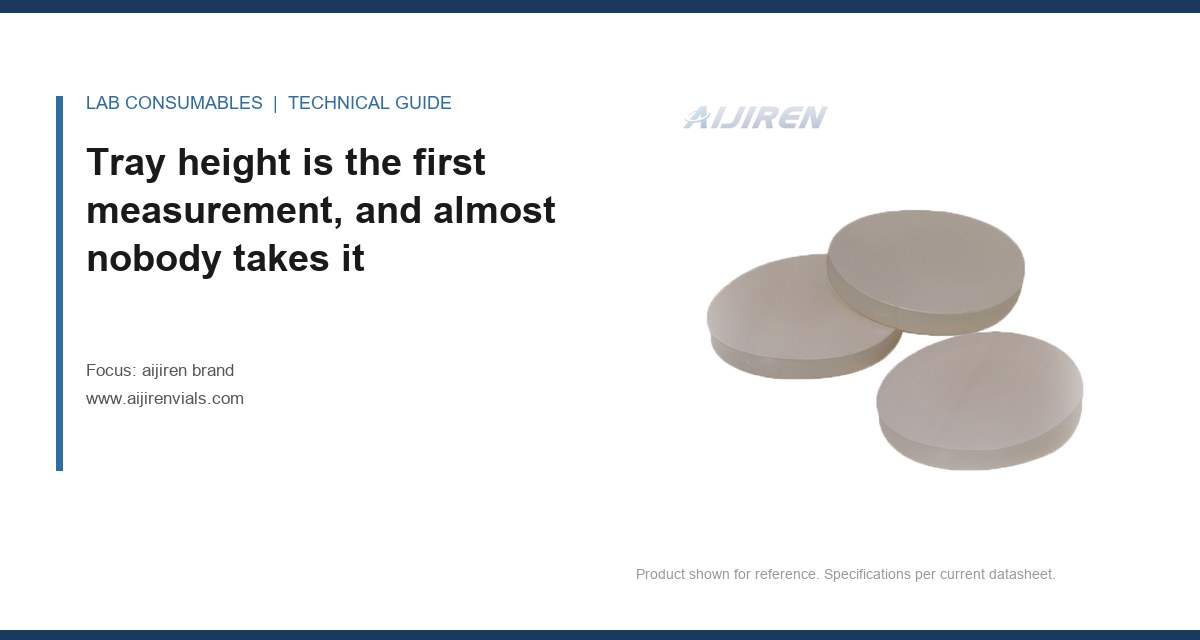
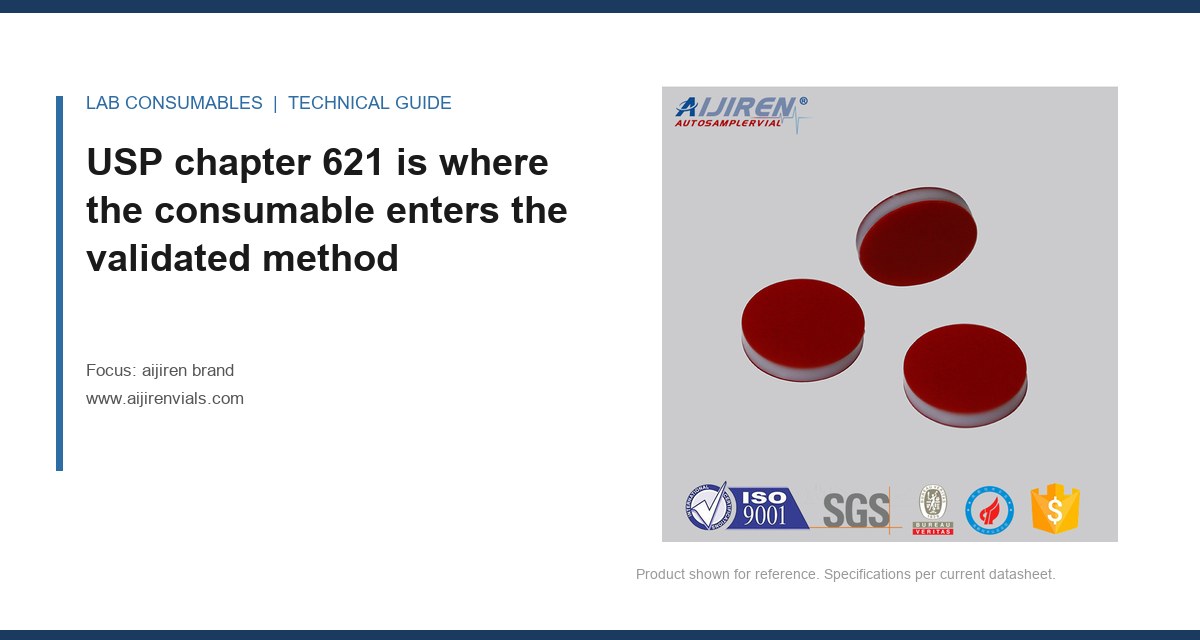
A septa rated for 100 punctures is not guaranteed to seal perfectly on puncture 100. It is guaranteed to survive 100 punctures without gross failure such as coring or tearing. The sealing performance degrades before the mechanical failure point. For a validated method with a 1.0% RSD requirement, I replace septa at 50% of the rated puncture count. If the septum is rated for 100 punctures, I replace it at 50. If it is rated for 50, I replace it at 25. That is not a USP number. It is a margin I built after watching area RSD climb from 0.6% to 1.4% between puncture 60 and puncture 80 on a silicone/PTFE closure.
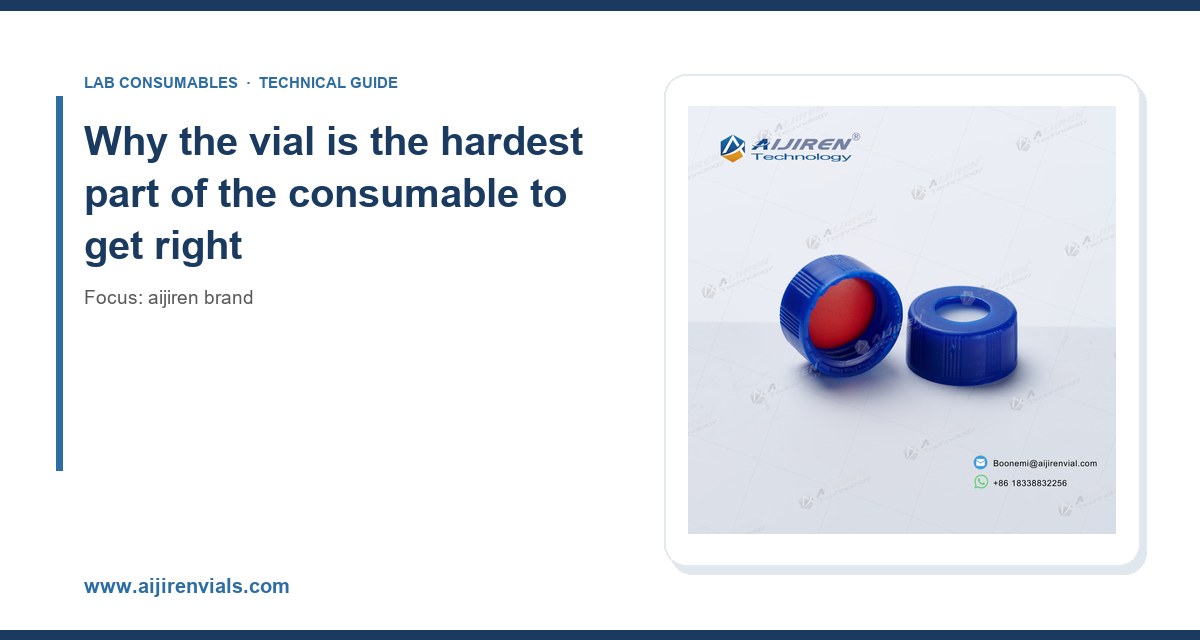
The torque on a screw cap matters more than most analysts think. A 9 mm screw cap on a 12 x 32 mm vial should be tightened to a consistent torque. Too loose, and the septum does not compress enough to seal. Too tight, and the septum deforms and the needle tears the PTFE layer on entry. I use a calibrated cap torque of 18 N·cm for 9 mm screw caps. Hand tightening varies from 10 to 30 N·cm depending on the analyst, and that variation is enough to change injection precision. The vial septa specification in a validated method should include a torque value, not just a cap type.
Dimensional tolerance and the autosampler interface
USP 621 assumes the autosampler can deliver a reproducible injection volume. That assumption breaks when the vial height varies. A 12 x 32 mm vial with a height tolerance of ±0.25 mm is standard. A vial at 32.25 mm and a vial at 31.75 mm both fit the tray, but the needle depth relative to the septum changes by 0.5 mm. That changes the puncture angle and the force required to pierce the septum, which changes the wear rate on the needle and the septum.
The neck finish matters too. A 9 mm screw neck has a defined thread profile. If the vial neck is molded slightly undersized, the cap does not seat fully and the septum compression is inconsistent. If it is oversized, the cap binds and the analyst overtightens. I have measured neck outer diameter variation of 0.15 mm across a single tray of budget vials. That variation produced a 0.3% RSD shift in a method that was validated at 0.8%. The fix was switching to a Aijiren brand lot with a documented neck diameter tolerance of ±0.05 mm.
The autosampler needle is the other half of the interface. A 23-gauge needle with a 22° bevel is standard for HPLC. A 26-gauge needle is used for some GC autosamplers. The septum must be rated for the needle gauge. A septum rated for 23-gauge needles may core when a 26-gauge needle is used because the smaller needle has a sharper tip and a smaller cross-section, which concentrates the puncture force on a smaller area. I specify the needle gauge in the consumable qualification document, and I match the septum to it.
Case: the GC method that failed after a septum lot change
A GC method for residual solvents in a pharmaceutical intermediate was validated with an RSD of 0.9% on the main peak. Six months after validation, the RSD climbed to 2.2% and the internal standard area dropped by 15% across a 20-run sequence. The column was fine, the inlet liner was clean, and the detector passed its calibration check.
The measurement that identified the problem was a septum leak test. I capped a vial with the new septum lot, punctured it 10 times with the autosampler needle, and then weighed the vial before and after a 30-minute hold at 60°C. The weight loss was 0.8 mg. The previous septum lot lost 0.2 mg under the same conditions. The new lot was a silicone formulation with a lower durometer, and it did not reseal after puncture at the method's inlet temperature.
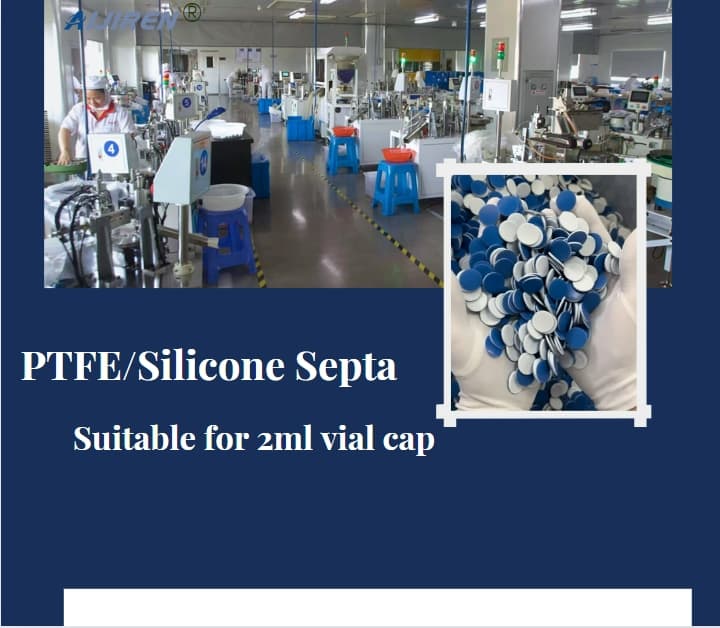
The fix was a return to the original septum specification: 55 Shore A silicone with a 0.010 inch PTFE facing, rated for 50 punctures at 200°C. The vendor had substituted a 45 Shore A lot without a change notification. The method was not at fault. The consumable specification was not enforced at the receiving inspection step. I added a septum durometer check to the incoming QC procedure, and the method returned to 0.9% RSD within one sequence.
Case: the LC-MS ghost peak traced to the vial liner
An LC-MS method for a peptide impurity profile developed a cluster of ghost peaks between 4.2 and 4.8 minutes in the blank injection. The peaks were absent in the first injection, appeared after the vial sat in the autosampler for 2 hours, and grew with residence time. The method used a 0.1% formic acid in acetonitrile diluent.
The measurement that identified the problem was a direct infusion of the vial extract. I filled a vial with the diluent, capped it with the suspect closure, held it at 25°C for 4 hours, and infused the liquid directly into the MS without a column. The m/z 355 and m/z 371 ions appeared. These matched a known siloxane series from a silicone septum that was not fully shielded by its PTFE layer. The septum was a PTFE/silicone laminate, but the PTFE layer was 0.005 inch thick, and the needle puncture exposed the silicone core to the solvent.
The fix was a septum with a 0.010 inch PTFE facing and a pre-slit design that reduced the puncture force and the exposed silicone area. The ghost peaks disappeared. The method's detection limit for the peptide impurities was 0.05 µg/mL, and the silicone extractables had been running at 0.2 µg/mL equivalent concentration. That is a 4x interference at the method's working range.
The consumable specification table for a validated method
Every validated method should have a consumable specification attached. I use this table as the minimum for HPLC and GC methods. The numbers are specific to aijiren brand vials and closures, but the structure applies to any qualified consumable.
| Parameter | HPLC specification | GC specification | Verification method |
|---|---|---|---|
| Vial dimensions | 12 x 32 mm, height ±0.25 mm | 12 x 32 mm, height ±0.25 mm | Caliper check per lot |
| Neck finish | 9 mm screw, diameter ±0.05 mm | 9 mm screw, diameter ±0.05 mm | Go/no-go gauge |
| Septum material | PTFE/silicone, PTFE 0.010 inch | PTFE/silicone, PTFE 0.010 inch | Vendor CoA review |
| Septum hardness | 55 Shore A ±5 | 55 Shore A ±5 | Durometer check per lot |
| Puncture rating | 100 punctures, replace at 50 | 50 punctures, replace at 25 | In-use monitoring |
| Cap torque | 18 N·cm ±2 | 18 N·cm ±2 | Calibrated torque driver |
| Extractables blank | Clean at method LOD in actual diluent | Clean at method LOD in actual diluent | Blank extraction per USP 1664 logic |
| Needle gauge | 23-gauge, 22° bevel | 26-gauge, 22° bevel | Autosampler manual |
| Pre-slit | Optional, reduces puncture force | Required for 26-gauge needles | Vendor specification |
This table is not a USP requirement. It is the lab's translation of USP 621, 661, and 1664 into a consumable specification that can be verified. The verification method column is what makes it enforceable. A specification with no verification method is a wish, not a control.
What USP leaves to the lab, and what that means in practice
USP will not tell you how many punctures a septum should survive in your specific method. It will not tell you what torque to apply to a 9 mm cap. It will not tell you which extractables are acceptable in your sample matrix. Those are lab decisions, and they must be documented in the method validation package.
The practical consequence is that a consumable change becomes a method change. If you switch from one septum lot to another, and the new lot has a different durometer or a different PTFE thickness, you have changed a variable that the method validation did not cover. The correct response is a re-qualification: run the system suitability test, run a blank extraction, and verify that the method still meets its precision and accuracy requirements. I have seen labs skip this step and then spend 3 days troubleshooting a method that was fine. The consumable was the problem, and the re-qualification would have caught it in 2 hours.
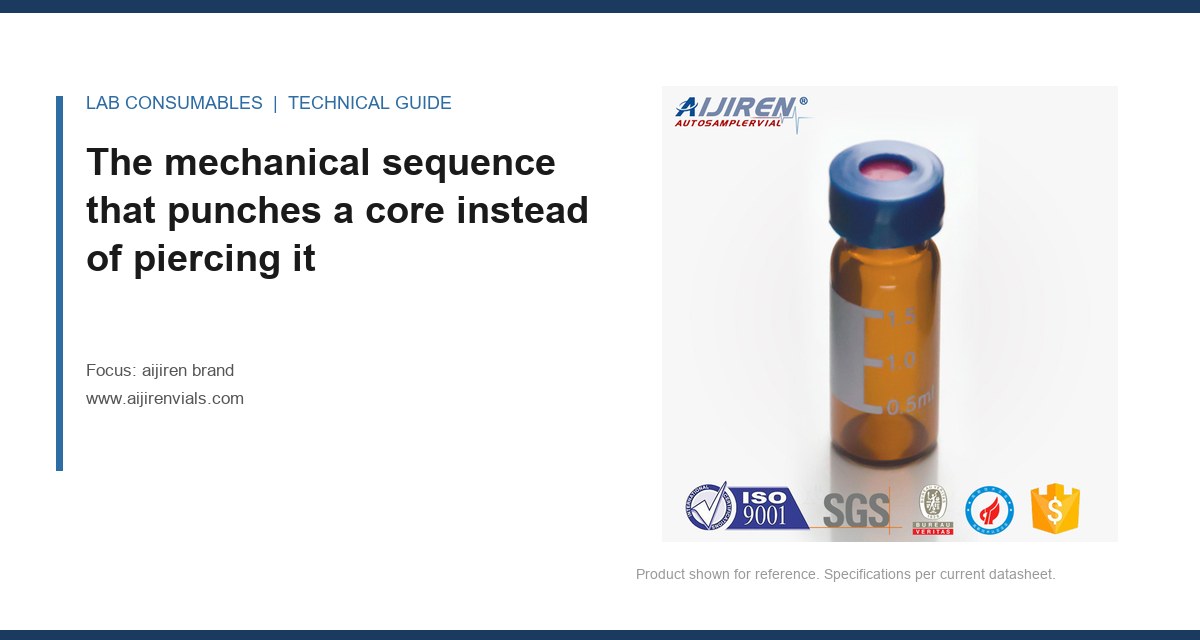
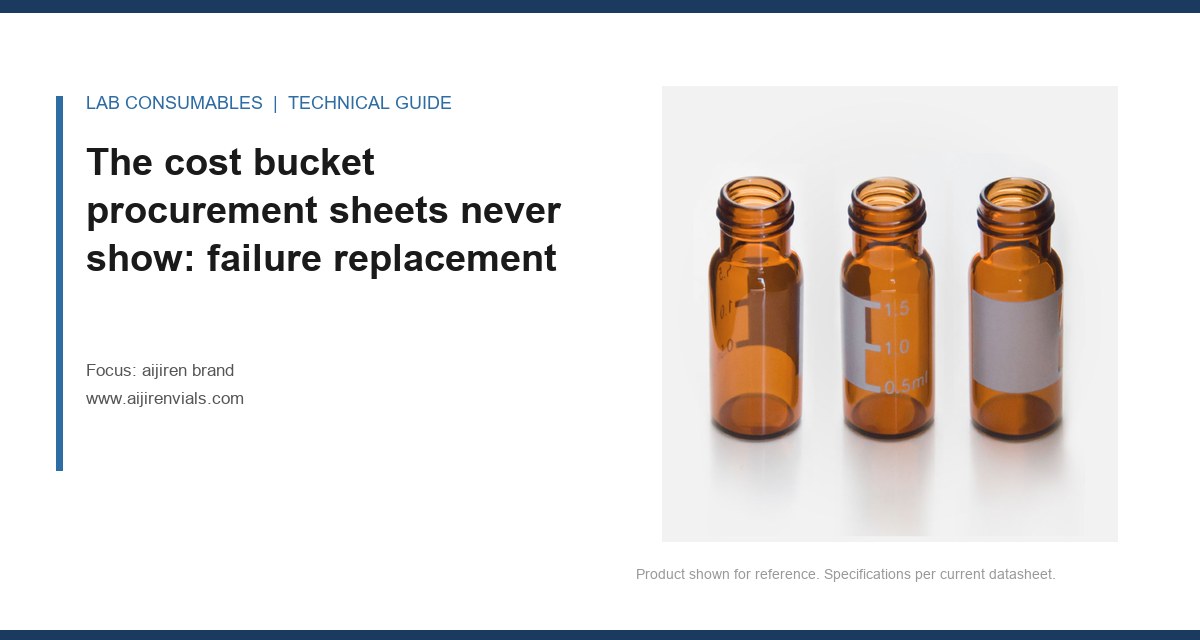
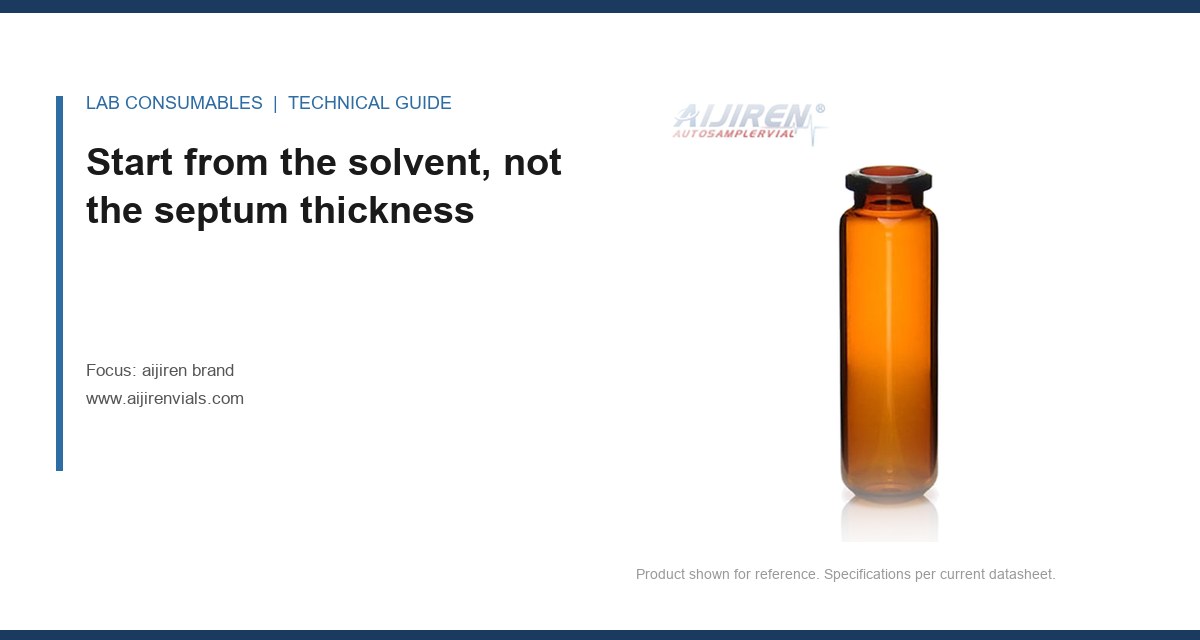
The same logic applies to the vial body. A Voa Vial with a different glass formulation may have a different surface chemistry. Type I borosilicate glass is the standard for HPLC and GC. Type III soda-lime glass is cheaper but can leach sodium and calcium ions into aqueous samples at low pH. If the method was validated with Type I glass, switching to Type III is a method change, not a cost saving. I specify Type I Class A borosilicate for all validated methods, and I reject any substitution without a re-qualification.
The troubleshooting sequence when a validated method drifts
When a method that passed validation starts to drift, the consumable is the first suspect. I use this sequence, in this order, because it isolates the consumable variables from the instrument variables:
- Step 1: Inject the same standard vial 6 times without removing it from the tray. If the RSD is ≤1.0%, the autosampler and the injection mechanism are fine. If it is higher, the septum may be leaking on repeat punctures.
- Step 2: Prepare 6 fresh vials from the same standard solution and inject each once. If the RSD increases compared to Step 1, the closure system is the variable. The septum compression or the cap torque is inconsistent.
- Step 3: Run a blank extraction in the actual diluent with the suspect closure. Hold at the method temperature for the maximum sample residence time. If extractables appear, the closure is the problem.
- Step 4: Check the vial height and neck diameter on 10 vials from the current lot. If the variation exceeds ±0.25 mm on height or ±0.05 mm on neck diameter, the vial lot is out of specification for the autosampler interface.
- Step 5: Check the septum puncture count. If the septum has been punctured more than 50% of its rating, replace it and re-run the system suitability test.
This sequence takes about 90 minutes to complete. It beats replacing the column, the detector lamp, and the autosampler needle one at a time while the method stays down. The consumable is the cheapest and fastest variable to check, and it is the most common failure point in my experience.
Where Agilent, Thermo Fisher, and Restek fit into the USP picture
Instrument manufacturers publish consumable compatibility guides, and those guides are useful for dimensional fit. Agilent documents the autosampler tray geometry for its 1100/1200/1260 series HPLC systems. Thermo Fisher documents the injection port requirements for its Trace series GC systems. Restek publishes technical resources on septum selection and inlet maintenance. None of these documents is a USP requirement, but they are the practical reference points that a lab uses to translate USP performance requirements into a consumable specification.
The U.S. EPA SW-846 methods are a separate regulatory framework, and they have their own consumable requirements. I mention them only to mark the boundary: this article covers USP requirements, not EPA method requirements. Mixing the two in a validation package creates confusion because the acceptance criteria and the documentation expectations differ.
The decision rule for qualifying aijiren brand in a USP-validated method
Qualify the consumable before the method, not after. Write the vial dimensions, the septum material and hardness, the cap torque, the puncture replacement point, and the extractables blank into the validation package. Verify each parameter on every lot. When a parameter drifts, treat it as a method deviation and re-qualify before running samples.
USP 621 sets the precision bar at ≤1.0% RSD for replicate injections. USP 661 and 1664 set the chemical compatibility and extractables framework. USP 381 defines the self-sealing expectation for elastomeric closures. None of them names aijiren brand. The lab names the brand, and the lab owns the proof that the brand meets the method's requirements. That proof is the consumable specification, and it is the only thing standing between a validated method and a sequence that fails at 6.8% RSD on a Tuesday afternoon.
References & further reading
Related resources from our lab consumables network:
- Aijiren Brand at aijirenvials.com
- Voa Vial at voavial.com
- Septa at septacaps.com
- Vial Septa at vialsepta.com
External references and standards: